Case Study · East Bangalore

Where Bangalore actually jams, and what to fix first

A bottleneck is a spot that slows down at the same place, in the same hours, on most days, so it is predictable, and therefore fixable. We read 32 days of live road-speed data from Google Maps Roads Management Insights (RMI) across East Bengaluru, the Whitefield, Kadugodi and Hoodi corridor, found the spots that jam again and again, and ranked the worst 15 by how badly they hurt drivers.

Area analysed
East Bengaluru (Whitefield to Hoodi)
Window
05 May to 05 Jun 2026 (32 days)
Found
142 recurring bottlenecks
Data source
Google Maps RMI road-speed
142recurring bottlenecks found across the zone
4.3 minextra on every km at the worst spot
2.2×slower than normal at the worst spots
8 of 15choked about 14 to 15 hours a day, not just rush hour
The decision page

Predictable jams are fixable jams

The worst spot, #1, sits right on the Whitefield to Kadugodi metro corridor, and the top spots stay choked for most of the day. They are not rush-hour spikes you can wait out. The good news: most of the 15 can be eased with signal retiming, enforcement and bus bays, paint and policing, not concrete. Only two need real road-widening budgets.

The top 5 get a full work-up below: when each jams, why, and the cheapest first move. All 15 sit on the watchlist, with the measured numbers for every one.

9 + 6Junctions and open roads9 are junctions, 6 are roads too narrow for their traffic
0.7 to 2.9 kmBack-up per spothow far each of the 15 jams stretches, about 750 segments in all
14 of 15Jam on weekends tooonly one spot is weekend-only, so this is built into the roads

Measured, not modelled. Speeds are each road against its own free-flow normal, never a single city-wide number.

The shortlist

The 15 worst spots, ranked by how badly they hurt drivers

Ranked by severity: how deep the slowdown is, multiplied by how far it backs up, multiplied by how often it happens. A spot that is bad every day outranks one that is bad occasionally. The dot tells you if you can plan around it.

Worst 3 deepest and most frequent High spots 4 to 10 Watch spots 11 to 15
#Where it isKindSlows toHow much slowerDays jammedWhenFirst move
1 Whitefield Main Rd × Channasandra Main RdKadugodi / Hopefarm 4-way crossing 7.7 / 17.2 2.2× 32/32 7:50 am to 11:20 pm Retune lights + keep box clear
2 Whitefield–Hoskote Rd (SH-35) × Belathur Main RdBelathur, Kadugodi T-junction 17.4 / 34.8 2.0× 32/32 7:40 am to 11:10 pm Retune + clear kerbs
3 Channasandra Main Rd junction complexChannasandra / Kadugodi T-junction 14.9 / 26.0 1.8× 32/32 Morning + evening One junction + retune
4 Whitefield Main Rd × Hagadur RdRamagondanahalli T-junction 12.9 / 25.9 2.0× 31/32 8:10 am to 10:30 pm Retune + bus bay
5 Whitefield Main Rd × Immadihalli RdSathya Sai Layout T-junction 15.9 / 29.8 1.9× 31/32 2:40 pm to 11:10 pm Retune + sync drain
6 Immadihalli Rd, narrow stretchSai / Vinayaka Layout Narrow road 18.5 / 31.7 1.7× 31/32 Morning peak Widen + clear road
7 Whitefield Rd merge, under the metroBelathur / Prashanth Ext. Lanes merge 10.3 / 20.7 2.0× 32/32 7:50 am to 12 pm, 4 pm to 10:40 pm Auto / taxi stand
8 Channasandra Main Rd × AKG Colony armAKG Colony, Kadugodi T-junction 11.8 / 23.6 2.0× 31/32 Morning + evening Fix together with #3
9 Immadihalli Rd corridor, feeder knotImmadihalli Narrow road 14.9 / 29.9 2.0× 23/32 Late-morning + evening Regularise road
10 Whitefield Main Rd × Gutta Rd, at metro stnPattandur Agrahara T-junction 13.3 / 24.6 1.9× 22/32 AM + PM peaks Retime + green-wave
11 Borewell Rd, narrow stretchNallurahalli / Palm Meadows Narrow road 16.1 / 32.2 2.0× 31/32 7:30 am to 10:40 pm wkdys One-way + no parking
12 Maithri Layout T, off SH-35Kadugodi, near metro terminus T-junction 21.4 / 42.8 2.0× 28/32 Evening peak Channelise + manage metro
13 Varthur Rd (SH-35), narrow stretchThubarahalli / Meenakshi Layout Narrow road 15.7 / 31.3 2.0× 31/32 Daytime + evening Finish widening
14 2nd Main Rd feeder to Borewell RdNallurahalli Narrow road 13.8 / 27.6 2.0× 18/32 Evenings (weekend-leaning) Widen + relief route
15 Whitefield Rd under metro, station throatPattandur Agrahara / Hoodi Narrow road 15.0 / 32.0 2.1× 29/32 Afternoon–evening Reclaim width

Slows to = average jam speed vs the road's own normal speed (km/h). Days jammed = days it recurred out of the 32-day window. #3 and #8 are two arms of one junction, listed separately. Source: TraffiCure on Google Maps RMI, 05 May to 05 Jun 2026.

#1–3

Act here first. Spots #1, #2 and #3 are the deepest, most frequent jams in the zone, and the costliest to drivers. #1 and #2 stay choked morning to night (and #1 sits on the metro corridor); #3 peaks morning and evening.

Read this once and the rest is easy

Two kinds of jam, and the right fix for each

Every spot is one of two things, and almost all cut traffic to about half its normal speed. So the difference below is about why, not how bad.

9 of 15 · junctions

Roads meet and lock each other up.

Two roads meet at one small spot. A poorly-timed signal and little channelization let turning and through-traffic fight for the same space, and the road ahead is often jammed too.

Fix: a proper signal, separate turn phases, and a keep-the-box-clear rule. Mostly paint and policing.

6 of 15 · open roads

The road itself is too narrow for the traffic.

No junction to blame, the road just cannot carry its traffic: a narrow residential short-cut, or a state highway never widened. Parked vehicles, vendors and in-lane bus stops shrink it further.

Fix: clear the kerbs, send through-traffic back to the main roads, and widen where it matters.

8 spots · jammed morning to night

These stay choked from morning into the night, about 14 to 15 hours a day, with no quiet hour to wait for. They are structural, so they need a real fix, not just timing advice (#1, #2, #4, #5, #7, #11, #13, #15).

7 spots · rush-hour peaks

These bite mainly at morning or evening peaks. Drivers can shift their timing, and wardens can be deployed just for those windows (#3, #6, #8, #9, #10, #12, #14).

A repeating theme: 4 of the 15 sit right under the elevated metro, whose pillars sit in the middle of the road and eat the turning space (#1, #7, #10, #15). And 14 of 15 jam on weekends too, so this is not just an office-commute problem.

The top 5, in depth

A full work-up on the five worst

For each of the five worst spots: when it jams, why it happens, and the cheapest first move, with the bigger fix to plan for later.

1

Whitefield Main Rd × Channasandra Main Rd

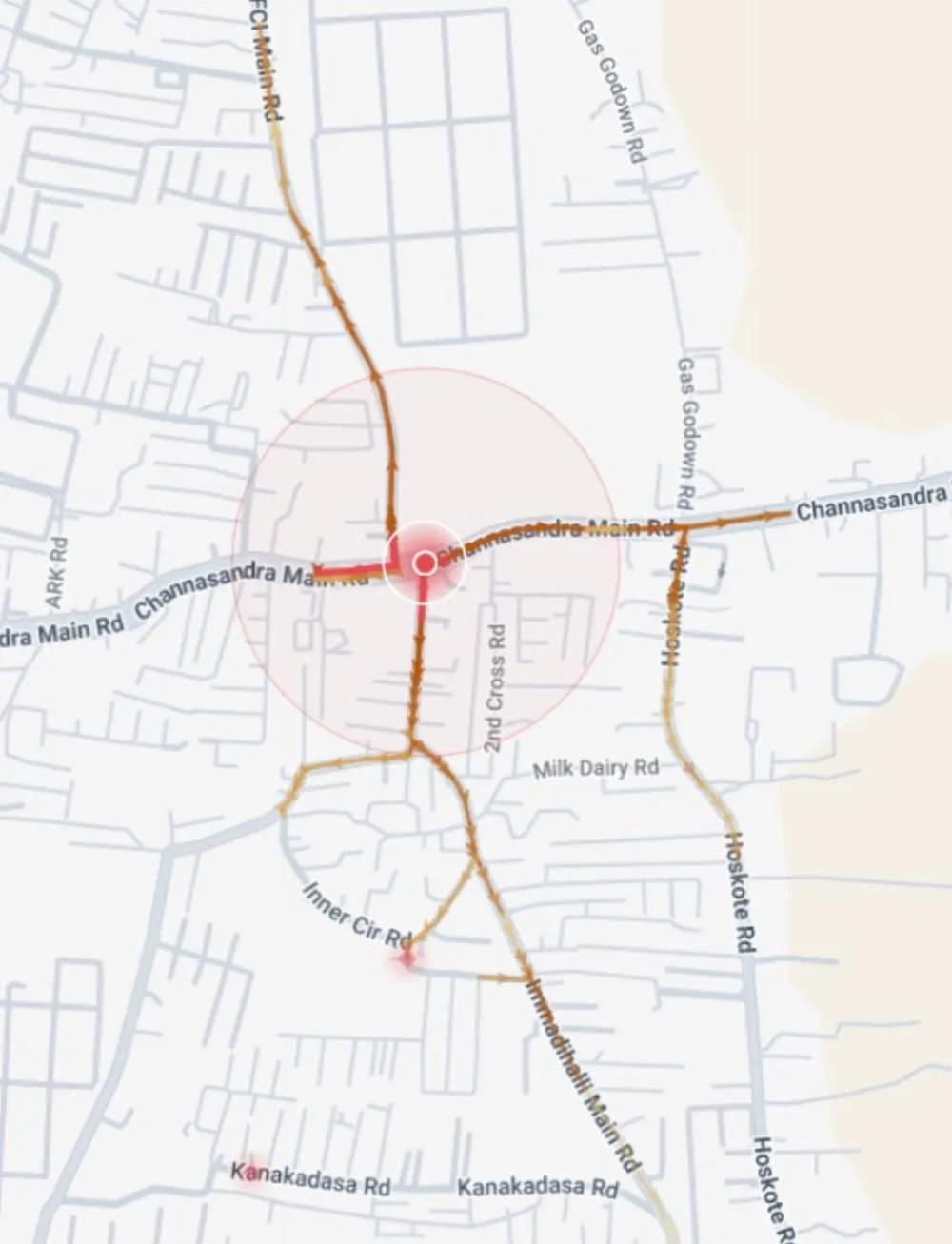
Kadugodi / Hopefarm · A 4-way crossing between two metro stations. Jams 7:50 am to 11:20 pm.

Worst in Bangalore
7.7Jam speed km/hnormal 17
4.3 minExtra per kmthe worst spot anywhere
1.7 kmBacks upall four arms
32/32Days it jamsevery day
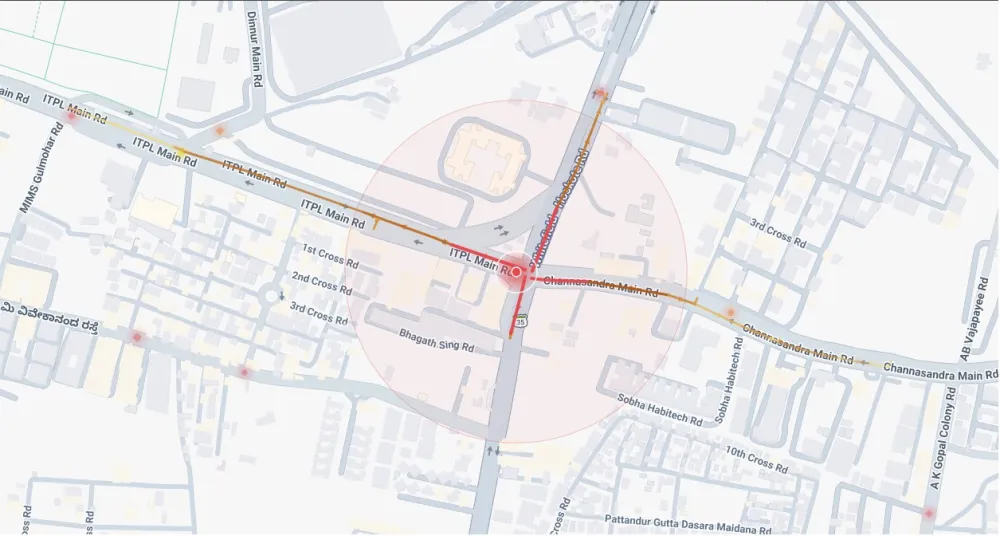
Location map of Whitefield Main Rd × Channasandra Main Rd, Kadugodi / Hopefarm
Where it is · Map data © Google
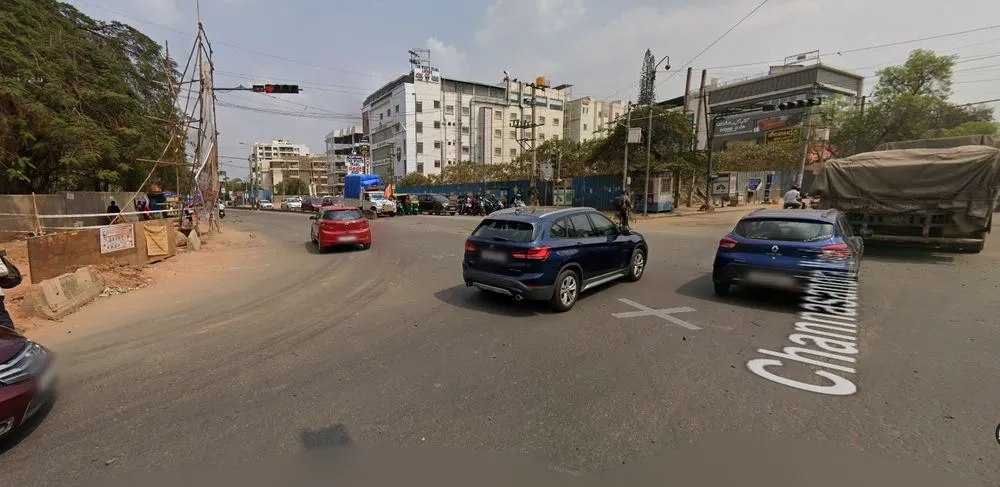
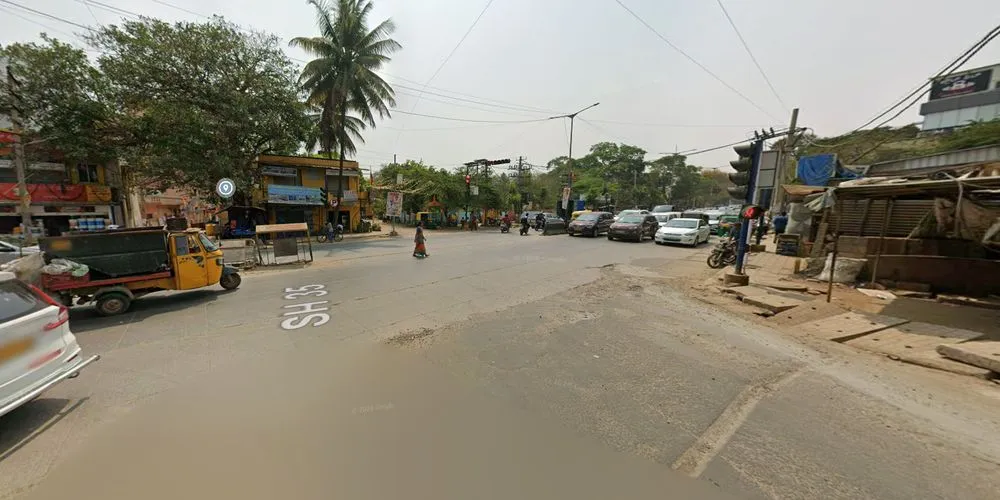
Street View of Whitefield Main Rd × Channasandra Main Rd, Kadugodi / Hopefarm
Street View · Imagery © Google
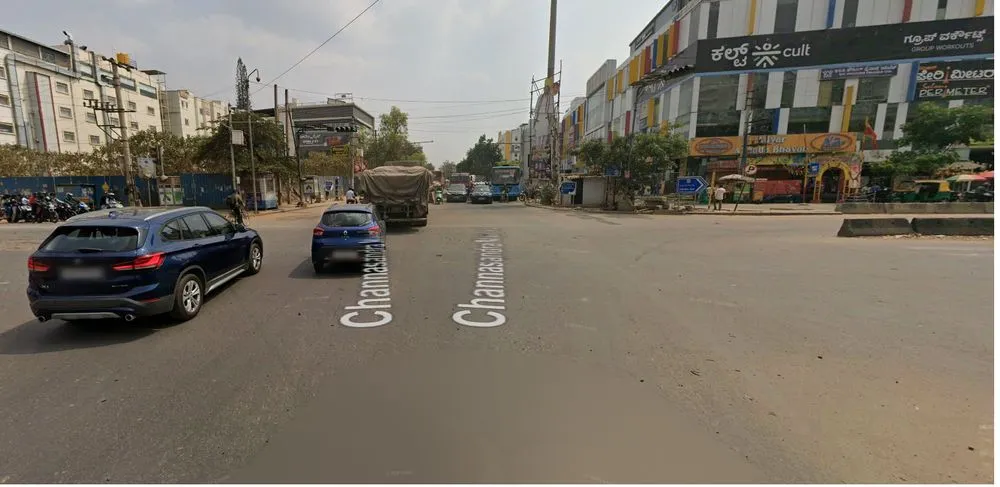
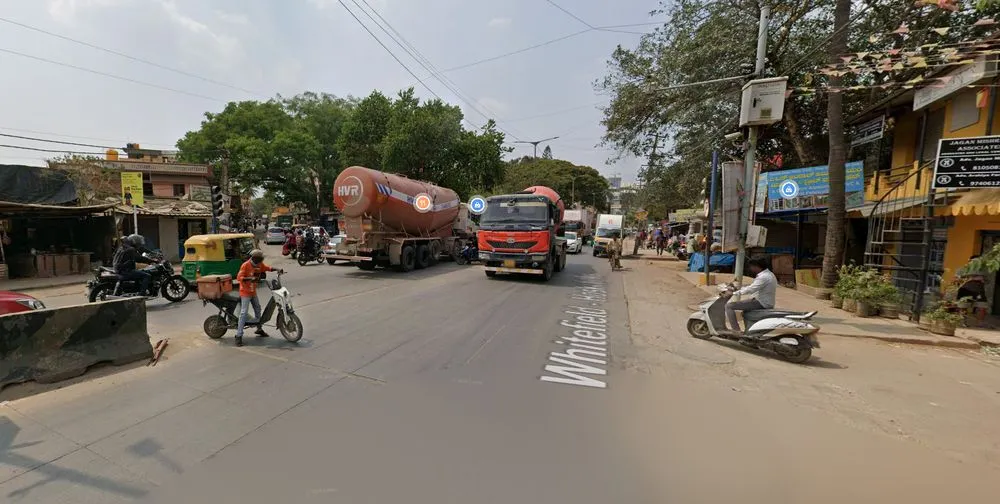
Street View of Whitefield Main Rd × Channasandra Main Rd, Kadugodi / Hopefarm
Street View · Imagery © Google
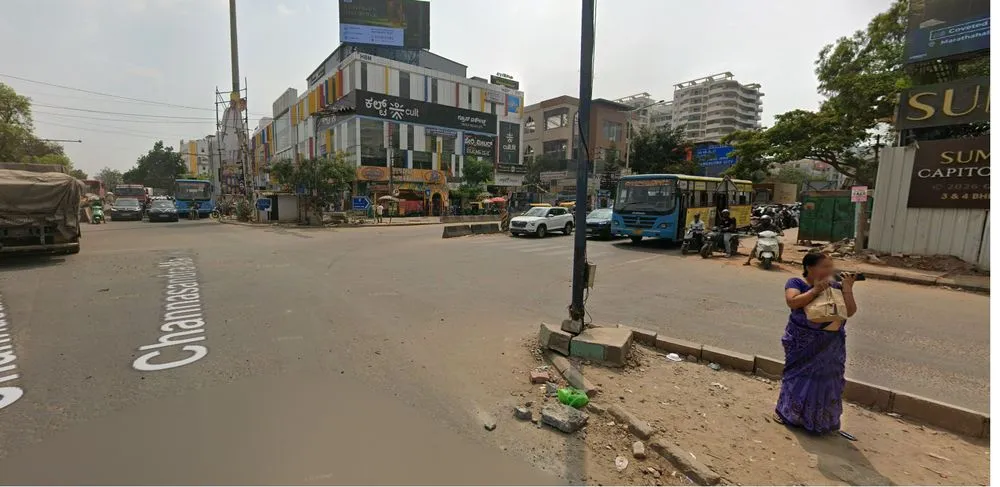
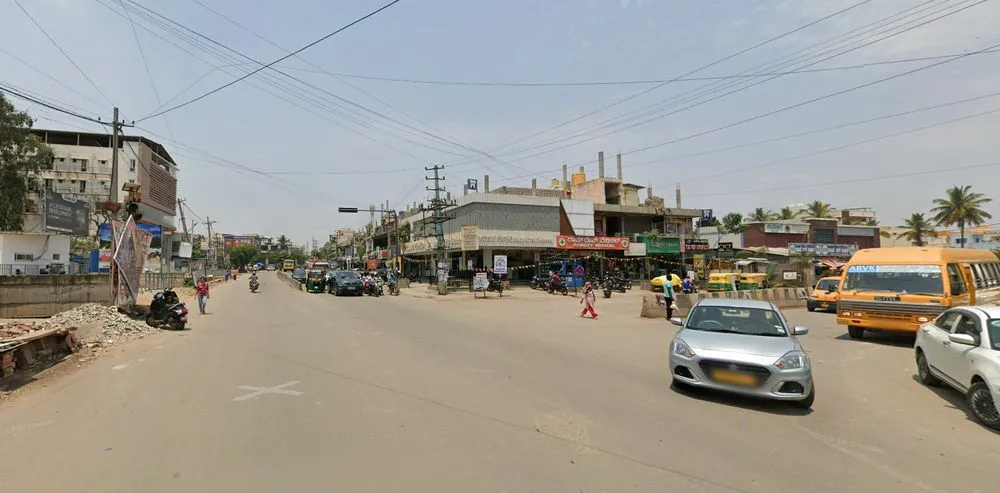
Street View of Whitefield Main Rd × Channasandra Main Rd, Kadugodi / Hopefarm
Street View · Imagery © Google
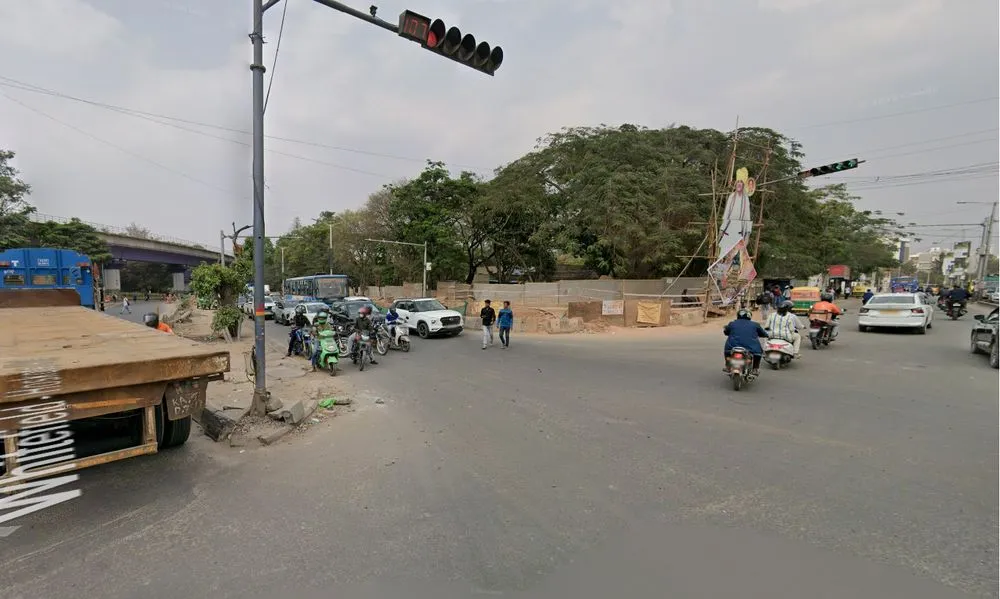
Street View of Whitefield Main Rd × Channasandra Main Rd, Kadugodi / Hopefarm
Street View · Imagery © Google

Why it happens

  • Two big roads cross at a tiny 220 m² spot, so eight lanes in and eight out fight for the same space.
  • Signal-controlled but a wide open-mouth crossing with no islands or turn lanes, and broken medians let vehicles U-turn anywhere.
  • Metro pillars eat the right-turn room, buses halt in the running lane, and traffic leaving the junction is itself stuck, so the queue cannot drain.
Cheapest first move

Audit and retime the existing signal: protected turn phases plus a strict keep-the-box-clear rule. Then add channelizing islands, turn lanes, and rebuild the broken medians.

Effort
Low to Med, no flyover needed
Cost
Low to start: paint, signal and median repair
Owner
Traffic Police + BBMP

Bigger fix, later Grade-separate the heavier road (a Hope Farm Junction underpass is already being fast-tracked here), and strengthen last-mile feeders to the two flanking metro stations to pull car trips off the crossing.

Spot #1 · Whitefield Main Rd × Channasandra Main Rd, Kadugodi / Hopefarm (12.9838, 77.7524)
2

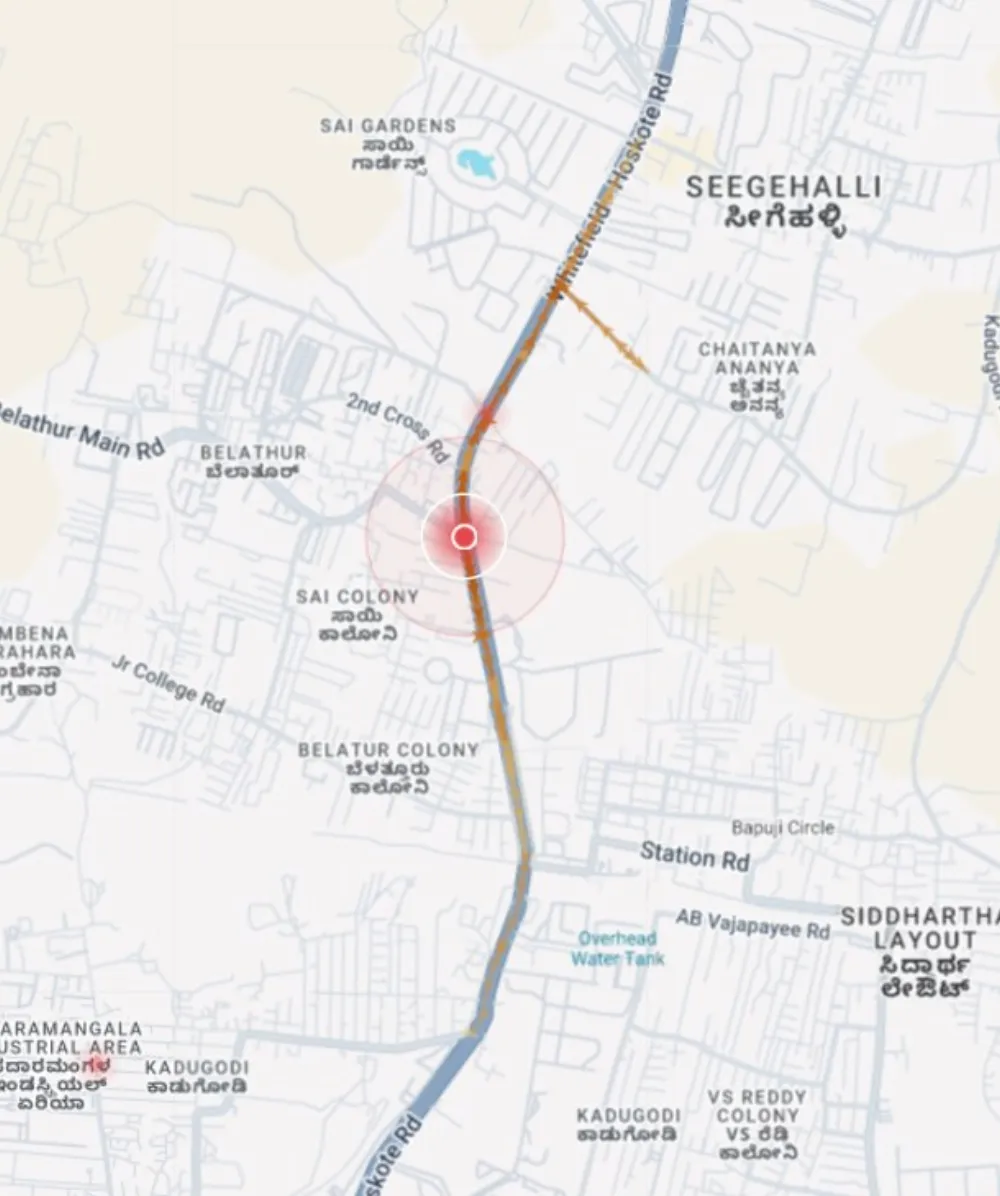
Whitefield–Hoskote Rd (SH-35) × Belathur Main Rd

Belathur, Kadugodi · A signalled T where a side road merges into SH-35 at a bad angle. Jams 7:40 am to 11:10 pm.

2nd worst
17.4Jam speed km/hnormal 35
1.7 minExtra per km2nd worst
2.9 kmBacks upboth ways
32/32Days it jamsevery day
Location map of Whitefield–Hoskote Rd (SH-35) × Belathur Main Rd, Belathur, Kadugodi
Where it is · Map data © Google
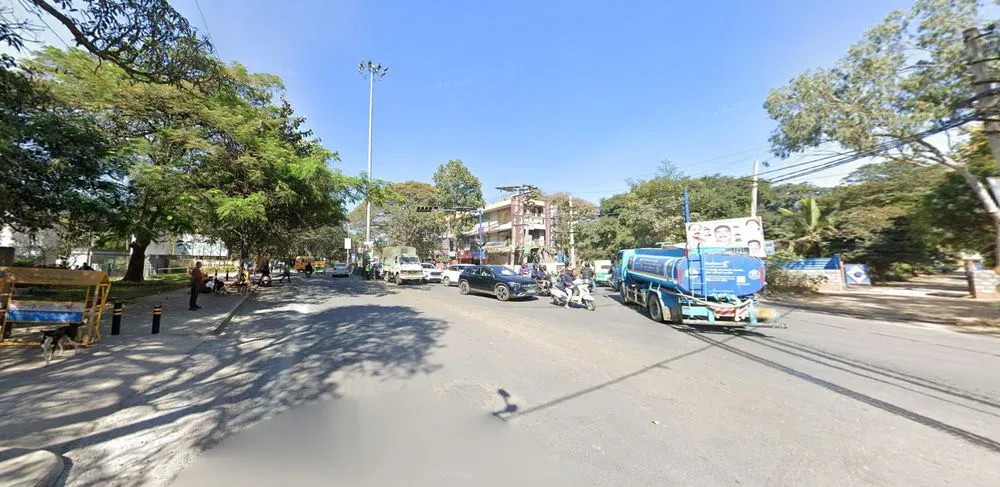
Street View of Whitefield–Hoskote Rd (SH-35) × Belathur Main Rd, Belathur, Kadugodi
Street View · Imagery © Google
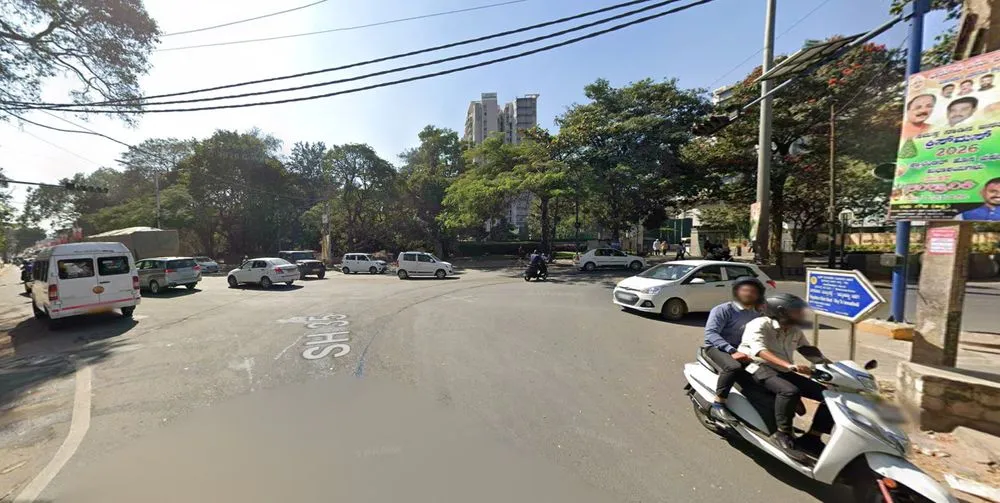
Street View of Whitefield–Hoskote Rd (SH-35) × Belathur Main Rd, Belathur, Kadugodi
Street View · Imagery © Google

Why it happens

  • A signalised T on a divided state highway, so the jams are friction-driven, not a missing signal.
  • Both approaches are choked by stalls, godowns and parked two-wheelers, and buses and autos halt in the running lane.
  • The broken median is used as an informal U-turn, the Belathur road merges at a skewed angle, and a railway bridge 1 km south stops the southbound queue draining.
Cheapest first move

Retime the existing signal with priority for SH-35 through-traffic and a metered turn for Belathur Rd; clear the roadside stalls and parking, move the bus and auto stand into an off-carriageway lay-by, and repair the broken median (one designed U-turn, not a free-for-all).

Effort
Low to Med, paint + enforcement
Cost
Low to start
Owner
Traffic Police + BBMP

Bigger fix, later Add a left-turn slip and channelizing island for the local-road merge; widen SH-35 and add turn pockets, and ease the southern railway-bridge and BMTC-terminus throat so the southbound side can drain (BBMP + Railways).

Spot #2 · Whitefield–Hoskote Rd (SH-35) × Belathur Main Rd, Belathur, Kadugodi (13.0042, 77.7570)

3

Channasandra Main Rd junction complex

Channasandra / Kadugodi · Two signals about 30 m apart, read as one wide unchannelled junction (#3 + #8). Morning and evening.

3rd worst
14.9Jam speed km/hnormal 26
1.7 minExtra per km3rd worst
2.4 kmBacks up75 connected roads
32/32Days it jamsevery day
Location map of Channasandra Main Rd junction complex, Channasandra / Kadugodi
Where it is · Map data © Google
Street View of Channasandra Main Rd junction complex, Channasandra / Kadugodi
Street View · Imagery © Google
Street View of Channasandra Main Rd junction complex, Channasandra / Kadugodi
Street View · Imagery © Google

Why it happens

  • Really two signalised junctions about 30 m apart, read as one wide unchannelled area, so the arms self-negotiate and lock up.
  • Only one of the four arms has a divider (and it is broken), so opposing and turning flows churn through the throat.
  • Hospitals, a college, a market strip and bus stops ring the junction, and a bus stop and auto stand sit inside the junction box itself.
Cheapest first move

Retime the existing signals and coordinate the two closely-spaced stop-lines; enforce a keep-the-box-clear rule so the two junctions do not grid-lock each other; add a protected left-turn where it helps; move the bus and auto stand out of the junction and clear the market encroachment at the mouth.

Effort
Med, paint, islands, signal retiming
Cost
Low to Med
Owner
Traffic Police + BBMP

Bigger fix, later Field-survey lane width and add turn lanes; improve the parallel Whitefield–Hoskote corridor so traffic stops diverting onto this street.

Spot #3 · Channasandra Main Rd junction complex, Channasandra / Kadugodi (12.9835, 77.7684)

4

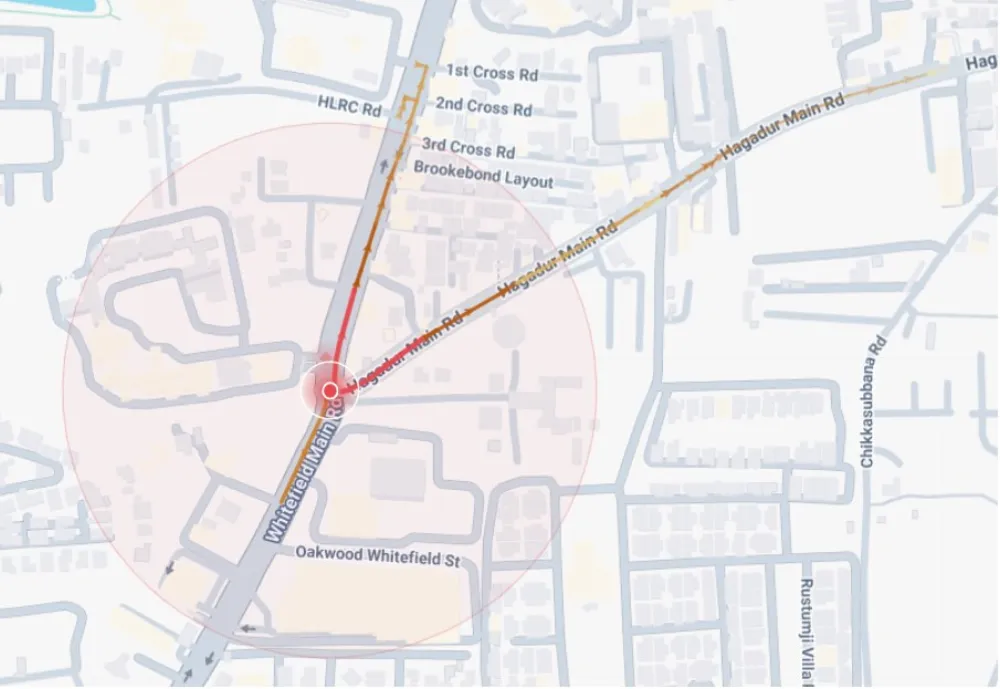
Whitefield Main Rd × Hagadur Rd

Ramagondanahalli · A signalled T where the main road bends through. Jams 8:10 am to 10:30 pm.

4th worst
12.9Jam speed km/hnormal 26
2.3 minExtra per km4th worst
1.1 kmBacks up29 connected roads
31/32Days it jamsalmost daily
Location map of Whitefield Main Rd × Hagadur Rd, Ramagondanahalli
Where it is · Map data © Google
Street View of Whitefield Main Rd × Hagadur Rd, Ramagondanahalli
Street View · Imagery © Google
Street View of Whitefield Main Rd × Hagadur Rd, Ramagondanahalli
Street View · Imagery © Google

Why it happens

  • A tight 3-arm T where the arterial bends through and the narrow Hagadur Rd joins, so all three approaches fight.
  • A wide, poorly-channelised mouth meets a one-lane stem, so turns sweep across each other.
  • A 705-flat gated complex, serviced apartments, a school and a bank all pull traffic into the small junction, with heavy kerb parking on top.
Cheapest first move

Retime the existing signal (a head is already on the corner pole) with a protected phase for the Hagadur merge; add a channelizing island, a left-turn lane for the stem, and a keep-clear box.

Effort
Low to Med
Cost
Low to start
Owner
Traffic Police + BBMP + School

Bigger fix, later Manage the apartment and hotel gate access (left-in / left-out plus internal drop-off bays); remove kerb parking, add a set-back bus and auto bay off the carriageway, and manage the school drop-off so it does not spill into the junction.

Spot #4 · Whitefield Main Rd × Hagadur Rd, Ramagondanahalli (12.9615, 77.7477)

5

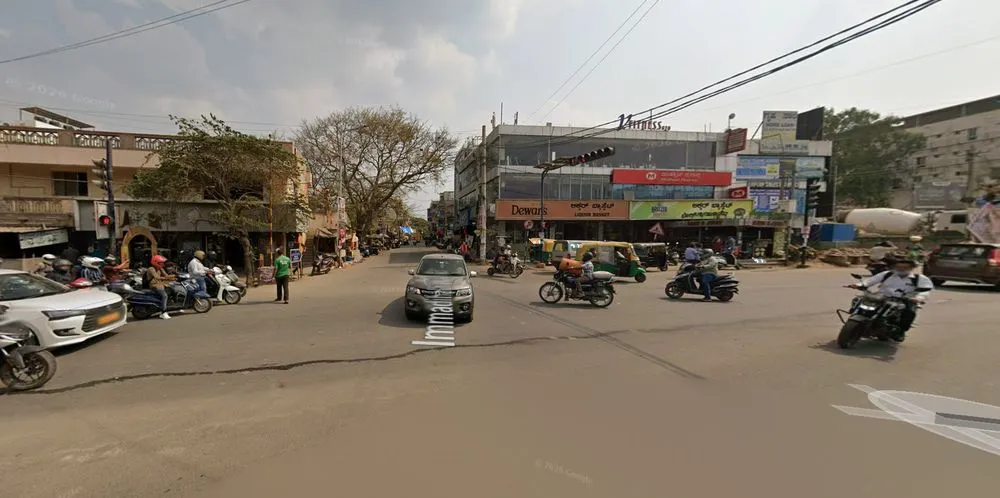
Whitefield Main Rd × Immadihalli Rd

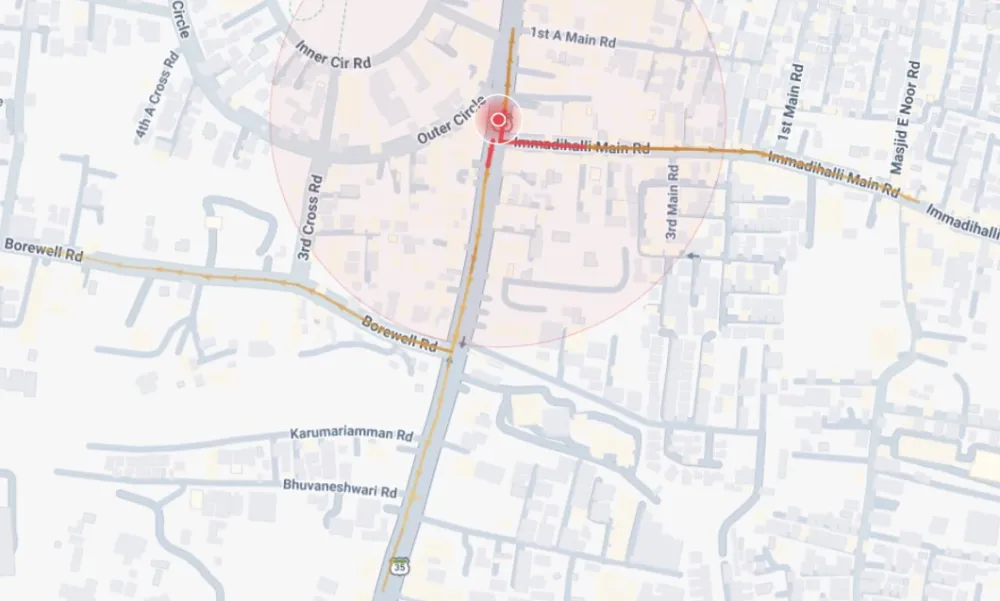
Sathya Sai Layout · A signalled T where the small side road cannot clear the saturated main road. Jams 2:40 pm to 11:10 pm.

5th worst
15.9Jam speed km/hnormal 30
1.8 minExtra per km5th worst
1.7 kmBacks up48 connected roads
31/32Days it jamsalmost daily
Location map of Whitefield Main Rd × Immadihalli Rd, Sathya Sai Layout
Where it is · Map data © Google
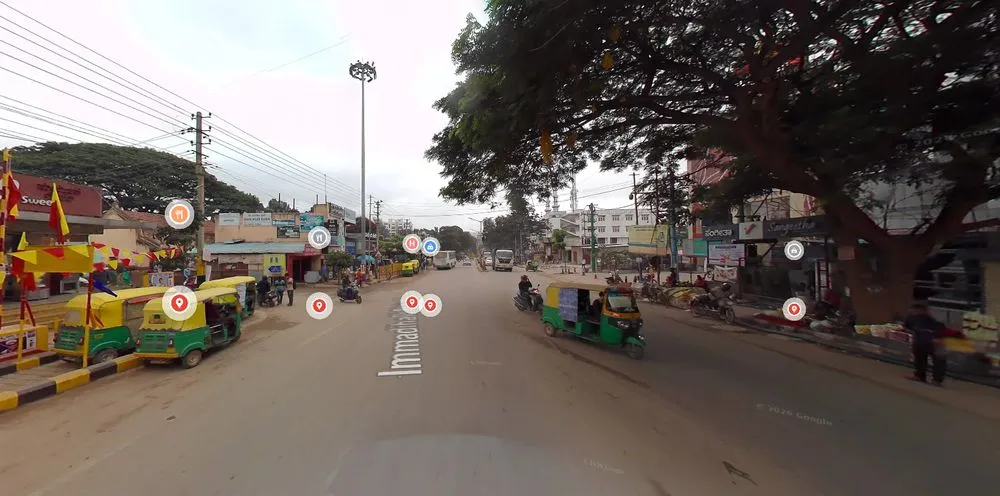
Street View of Whitefield Main Rd × Immadihalli Rd, Sathya Sai Layout
Street View · Imagery © Google
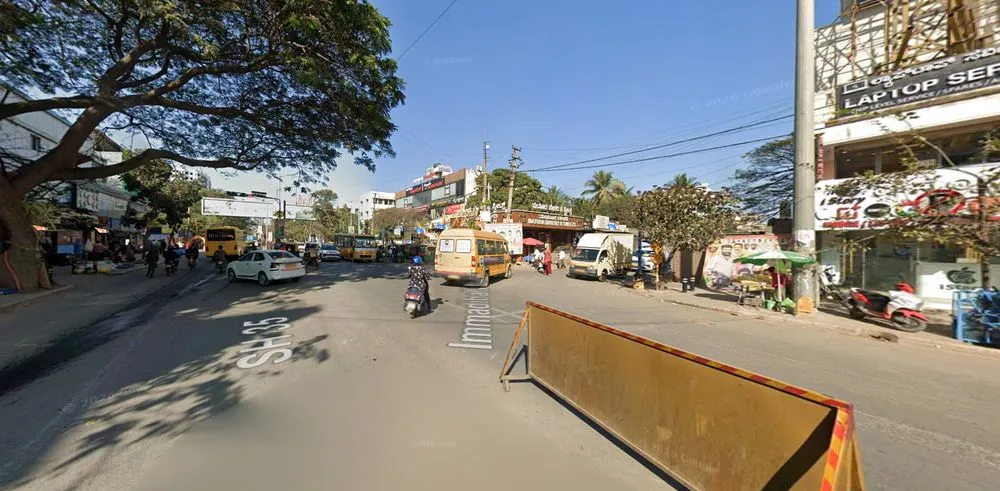
Street View of Whitefield Main Rd × Immadihalli Rd, Sathya Sai Layout
Street View · Imagery © Google
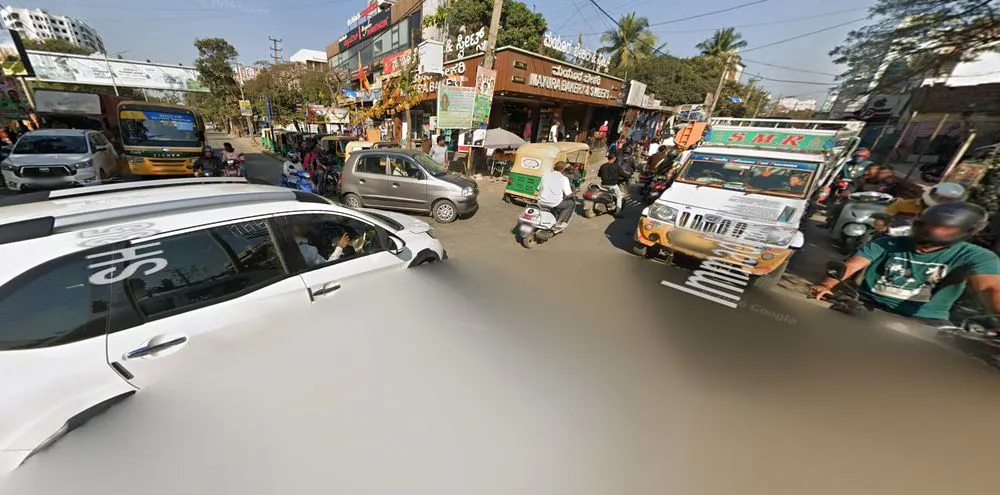
Street View of Whitefield Main Rd × Immadihalli Rd, Sathya Sai Layout
Street View · Imagery © Google

Why it happens

  • The road downstream is almost fully blocked, so the queue cannot clear and stacks back through the junction. This cannot-drain effect is the main driver.
  • The small, undivided Immadihalli feeder cannot discharge, so it takes a disproportionate hit every signal cycle.
  • A mall, a textile market and the dense Sathya Sai Layout pull parking, drop-off and pedestrians into the throat.
Cheapest first move

Retime the existing signals: give the small Immadihalli arm enough green and a keep-clear box; coordinate timing with the next junctions north and south so the queue can drain instead of stacking back.

Effort
Low to Med
Cost
Low to start
Owner
Traffic Police + BBMP

Bigger fix, later Declutter the Immadihalli approach throat (clear stalls and parking), add an off-carriageway bus lay-by, and widen the small feeder so it can discharge faster.

Spot #5 · Whitefield Main Rd × Immadihalli Rd, Sathya Sai Layout (12.9699, 77.7500)

Most of this needs paint and policing, not budgets

Four moves that cover all 15 spots

The 15 spots look different but they repeat the same handful of problems. Four interventions, three of them cheap and fast, cover every spot on the list. Start with the top two; they cost almost nothing and start working in weeks.

1

Fix the signals first

No construction · weeks · biggest quick win

9 of the 15 are junctions where roads simply fight for space. A proper signal, separate turn phases, and a strict keep-the-box-clear rule lift flow with paint and enforcement, no concrete. These junctions are already signalised; the problem is poor timing and missing lane channelization, not missing lights.

Covers #1, #2, #3, #4, #5, #8, #10, #12Low cost · Traffic Police + BBMP
2

Clear the kerbs, everywhere

All 15 spots · cheapest city-wide win

Every single spot is choked by the same three things on the ground: buses stopping in the running lane, vendor stalls and goods on the edge, and illegal parking. Real bus bays, marked vendor zones and parking enforcement recover lane width across the whole city.

Covers all 15, the biggest shared causeLow to Med cost · BBMP + BMTC + Police
3

Get through-traffic off narrow lanes

Re-routing + one-way pairs · medium effort

Several spots are narrow residential lanes used as short-cuts, for example Borewell Rd, used to skip the Hope Farm signal. Sign and route through-traffic back to the main arterials, and pair the worst as one-ways with a parallel street to double their capacity.

Covers #6, #9, #11, #14 (open-road crawls)Med cost · BBMP + Police
4

Reclaim the width metro pillars took

Restriping + last-mile · medium effort

4 spots sit right under the elevated metro, whose pillars eat the median and turn lanes. Restripe hard against the pillar line, formalise the metro bus and auto drop-off, and use the new ITPB skywalk to keep people off the road.

Covers #1, #7, #10, #15 (metro corridor)Med cost · BBMP + BMRCL
2

Only two spots actually need big budgets and time. Widening the narrow state highways: SH-35 at Kadugodi (#2) and Varthur Rd (#13), which is also the only route to the Outer Ring Road from that side. Everything else on this list can be started with signals, paint, bus bays and enforcement.

So you can trust it

How this was built, and where to be careful

  1. 1

    Where the numbers come from

    Road-speed data for Bengaluru East (Whitefield, Kadugodi, Hoodi), a 32-day window (05 May to 05 Jun 2026), at the road-segment level. Each road is compared to its own free-flow speed, so slow means slow for that road, not a city-wide number.

  2. 2

    How spots are ranked

    A transparent score: how deep the slowdown is, times how far it backs up, times how often it recurs. A spot that is bad every day outranks one that is bad occasionally; speed alone does not decide the order.

  3. 3

    What 32 days shows, and what it does not

    The window gives how often a spot jams, when, and the weekday-versus-weekend split. It does not support year-on-year trends or monsoon effects. With no traffic volumes, we show no rupee or vehicle-hours cost: the honest impact is minutes lost and how often.

Two honest data gaps for this cityChecked 25 Jun 2026

They affect the why, not the how bad. We have no land-use data for Bangalore yet, so causes (schools, malls, markets, bus stops) are read from public maps, Street View and OpenStreetMap. We also have no lane-count or road-width data, so road sizes are read from maps. The location map and Street View imagery for each top-5 spot are from Google (© Google), aimed at the bottleneck from its exact coordinates.

Read these as priorities, not verdicts. 32 days is a strong screen, and probe data under-samples two-wheelers, so ground-check the causes before spending. The cheapest moves (signals, kerb-clearing, bus bays) are safe to start now. Re-run the measurement after a fix to prove it worked.

Frequently asked questions.

What counts as a traffic bottleneck here?
A bottleneck is a spot that slows down at the same place, in the same hours, on most days, so it is predictable and therefore fixable. We read 32 days of road-speed data across Bangalore's eastern zone, found the spots that jam again and again, and ranked the worst 15 by how badly they hurt drivers.
How were the 15 worst spots ranked?
By a simple, transparent severity score: how deep the slowdown is, multiplied by how far it backs up, multiplied by how often it recurs. A spot that is bad every day outranks one that is bad occasionally. Speed alone does not decide the order.
What data window does this cover?
A 32-day window, 05 May to 05 June 2026, measured at the road-segment level across Bengaluru East (the Whitefield, Kadugodi and Hoodi area). Each road is compared to its own normal free-flow speed, so slow always means slow for that road, never a single city-wide number.
What does 32 days of data show, and what does it not?
It reliably shows how often a spot jams, when it jams (time of day), and the weekday-versus-weekend split. It does not support year-on-year trends or monsoon effects, and the patterns should be read as priorities to confirm on the ground, not final verdicts.
Why is there no rupee or vehicle-hours cost figure?
Because we do not have traffic volumes, we deliberately show no modelled rupee or vehicle-hours cost. The honest impact here is in minutes lost and how often a spot jams, not a modelled number. We flag the data gaps rather than hide them.
Can other cities get the same analysis?
Yes. Nothing about this is Bengaluru-specific. The same measurement works anywhere Google Maps has coverage. TraffiCure is 100% software, with no cameras or sensors, and deploys in weeks.
Commercial · 30 minutes

Get this ranking for your city, on your roads.

The same measurement works anywhere Google Maps has coverage. Rank the worst spots, tell junctions from open roads, and get the cheapest first move for each. Software only, no cameras or sensors, live in weeks.

Book a demo →